October 3, 2026
Birth of a Princess
The boy ran after the stray lamb, chasing it towards the rest of the small flock. "Go on, get back to your mother," he said as he chased it. The boy was running through the marsh, his bare feet splashing through the water as he ran. The lamb seemed annoyed and bleated in protest as she ran away from the boy, pushing through the reeds that were growing in the mud and water. Fortunately, she ran in the direction of the flock and was eventually reunited with her mother.
Abram, the ten-year-old boy, walked towards his father and older brothers who were standing on the bank, trying to keep the rest of the flock together. His father, Terah, was 140 years old. During that time in history, it was common for people to live several hundred years. It was also common for siblings to be substantially older than their younger siblings. That was evident between Abram and his oldest brother Haran. Haran was 70 years old and had several children. One of his children, Lot, helped with the flock of sheep. Abram's other brother was Nahor. Nahor was grown but hadn't gotten married yet.
"Come on, let's get the flock home before the lions and wolves come out for the night. We can't afford to lose any sheep," said Terah. "Our flock is already too small to feed our growing family."
They drove their flock towards the city of Ur where they lived. Ur was a bustling, wealthy city. Situated on the south side of the Euphrates River, it was a major trade center because it was near the Lower Sea and was the route most traders used going from Canaan to the Indus Valley and back. Cargo ships from the Indus Valley would sail along the coast towards Ur. They would stop at different ports along the way, trading their wares. Eventually they would enter the Lower Sea and make their way to Ur where they would do more trading before returning to the Indus Valley.
Traders also came from the other direction, from Canaan and Egypt. Caravans would bring goods along the route. When they got to the Euphrates River, they would either continue with their pack animals carrying the goods, or they would float the goods down the river to Ur by boat. Because it was hard to travel upriver in the boats, they would sell the lumber from the boats and travel by caravan back to Canaan. Ur had become a very busy hub of trade. Those who were skilled at trading goods became very wealthy.
The people who raised livestock weren't as wealthy because Ur wasn't the best place to pasture them. There weren't open pastures where they could graze the flocks. Instead they had to graze them in the marshy areas surrounding Ur. At night the sheep were kept in an area attached to their house that was surrounded by a mudbrick fence. Their house was also made of mudbrick since there was very little stone for building. In the morning, the flock had to be taken out of the city to the marshy area where grazing was allowed for personal flocks. Some areas were reserved to graze the sheep for the temples to worship the gods or for the royal flock. The family's sheep would graze on the reeds and other grasses that grew in the marsh. Abram and Lot usually stayed with the flock all day to be sure the sheep were safe. At the end of each day, Terah, Haran, and Nahor would come to the marsh and help drive the flock back through the busy streets to Terah's house.
As they walked towards the city driving the flock, they could see a huge ziggurat rising above the other structures in the city. The ziggurat had three layers with a temple on the top level. The temple was built to the moon goddess, Nanna. There were other smaller ziggurats that were used to worship other gods, because most people were polytheistic. Terah faithfully served Nanna as well as other gods, but Abram always felt there was something unsettling about worshipping them.
Abram thought about his ancestors, Noah and his son Shem. They currently lived farther north in Mesopotamia. They had been among the eight people who had survived the worldwide flood that God had sent because of the wickedness of men. The story of the flood had been passed down through the generations. However, most people had dismissed the story and worshipped other gods and goddesses instead of the God who had created the world and sent the flood in judgment of wickedness. In fact, Abram didn't know anyone who didn't worship the goddess Nanna and the other gods in Ur.
The city of Ur was the most advanced city in the known world. The previous king, Ur-Nammu, had established a code of law. There were punishments for people who broke the law, so the city was fairly peaceful. However, it was also a very busy, noisy city, especially around the harbor where most of the trading took place. Every day there were new ships coming and going. Scribes used a type of writing called cuneiform to record the trading transactions. They would use a cut reed to make marks on clay tablets. The clay could be reused over and over. However, if there was something people wanted to record that could be read many years in the future, they would bake the clay to make the writing permanent. Even though most people liked living in the big city of Ur, Abram preferred the quietness of the marshes where he tended the flock of sheep.
Abram and his family continued to drive the flock through the streets of the city until they got to their home. They had just gotten the flock settled in for the night when Abram's mother, Nintuda, came out of the house. "I'm glad your back," she said. "Hili had her baby. Come and see."
Terah had two wives, Nintuda and Hili. The family all went into the house. Hili was in a area sectioned off with a think curtain. Nintuda held the curtain back so the family could see the new addition to the family. Hili was resting on a mat on the floor, holding a beautiful baby girl in her arms. The baby's face was round and soft-looking. She had thick, dark hair and long, dark eyelashes that were closed in sleep. Her chest rose and fell gently as she breathed in the warm summer air.
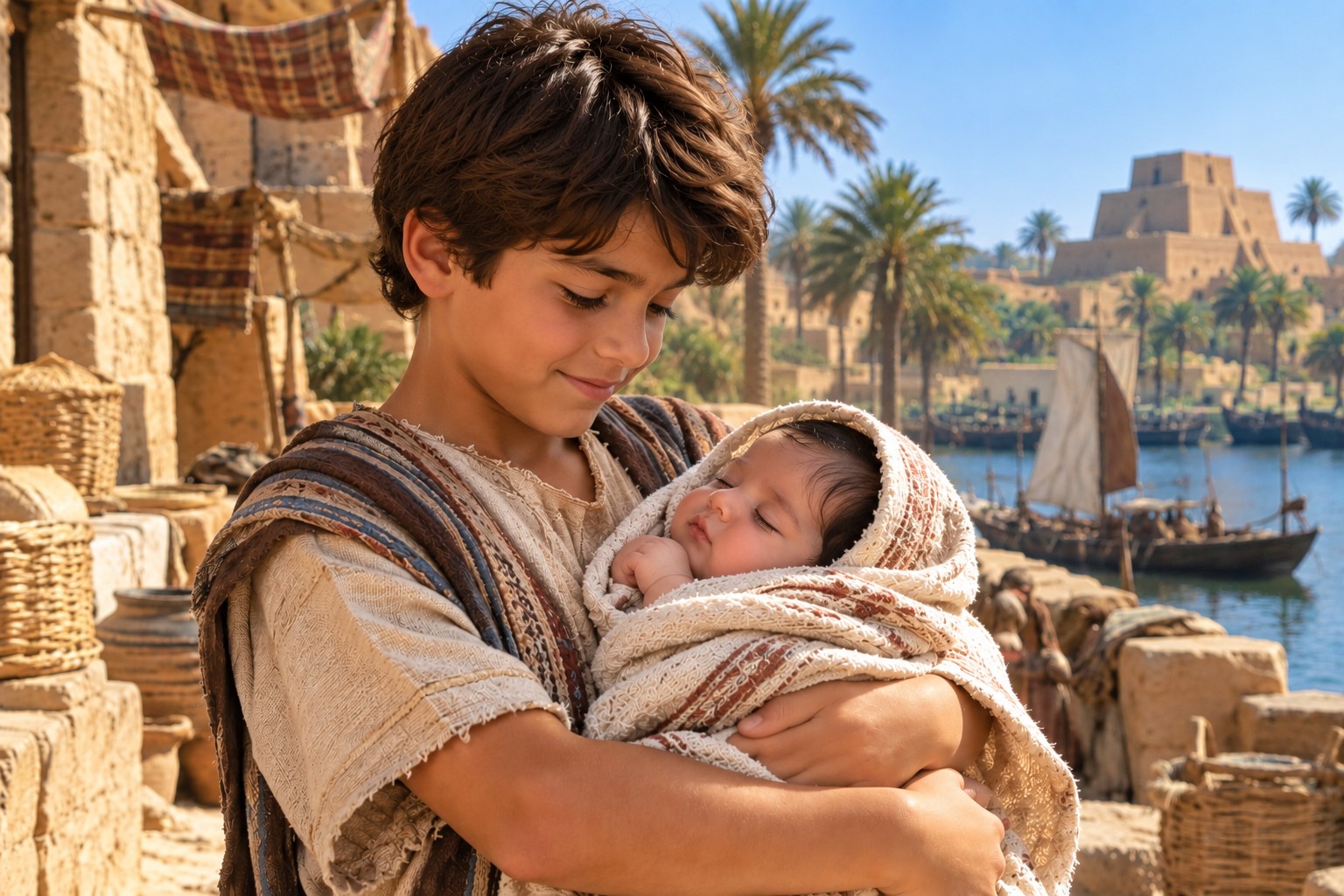
Abram was entranced by the little girl. He walked softly into the room and knelt beside Hili's mat, his eyes never leaving the baby. His hand went instinctively out to touch her, but then he drew it back, realizing it might not be right to do so.
"Would you like to hold her?" asked Hili.
Abram looked at Hili without saying anything, just nodding his head slightly. Nintuda knelt down and took the baby from Hili and placed her in Abram's arms. She made sure Abram had a secure hold on the baby before letting go. Abram didn't say a word. He just stared at the beautiful little girl in wonder.
"What are you going to call her?" asked Lot.
Hili looked up at Terah, raising her eyebrows in question. Terah said, "I think Sarai would be a perfect name for such a beautiful baby. It means princess."
"Alright, Sarai it is," responded Hili, smiling.
Nintuda said, "Hili needs some rest. Haran's wife has supper ready for all of you. You can go next door to their house and eat while I take care of Hili. Go on now." With that she started to shoo them out of Hili's room and towards the house where Haran and his family lived.
They all left except for Abram. He slowly rose to his feet, holding the precious bundle, still memorized. He seemed reluctant to give the baby back to Hili or his mother. He held Sarai close for a minute, gently touching her black hair. Then he whispered to her, "We're going to be best friends. I will always take care of you and protect you, my beautiful princess."